Panel announced: Beyond Troll Farms and Border Violence: Defying Disinformation and Dehumanization
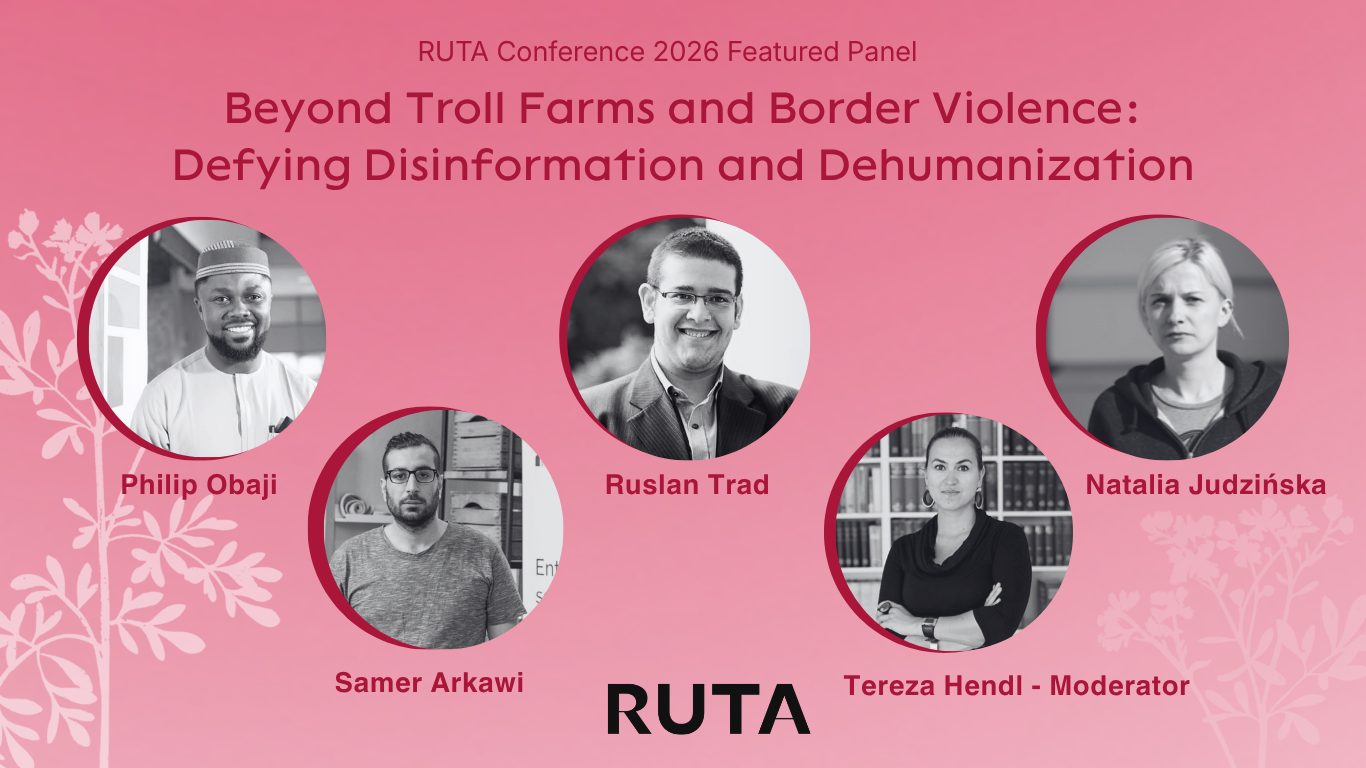
Featured Panel: “Beyond Troll Farms and Border Violence: Defying Disinformation and Dehumanization”.
Alongside its colonial aggression against Ukraine, Russia has been tightening its grip on Africa through a combination of military and hybrid tactics. As Philip Obaji’s journalism has exposed, Russian paramilitaries have left a trail of atrocities across the continent — brutalizing local communities in ways that destabilize African states and deliberately exacerbate migration toward a Europe that often does not welcome them. Deploying troll farms and influence networks, Russian disinformation campaigns sow division globally and actively incite racial hatred. At the same time, the Russian regime funds and promotes the international far right, manipulates foreign elections, and instrumentalizes migrants whose lives are endangered in the process.
These dynamics are also evident at the European Union’s borders: from the English Channel, where people on the move are pushed back into the sea, to the EU’s Eastern border, where Polish and Belarusian border guards force people into the freezing forests of the borderlands. Exploiting the historical traumas and deep-seated fears left by Russian-Soviet and Nazi-German occupations, Russia and Belarus portray migrants as “existential threats”, while the EU — and particularly Poland — frames them as a “weapon of hybrid warfare”. Meanwhile, Russia and Belarus continue to threaten sovereign nations with renewed occupation and carry out sabotage operations across Europe.
Amid these specters of violence, urgent questions arise: How can we more effectively resist disinformation and foreign interference at a time of escalating imperial violence and anxiety? In the absence of conditions that allow us to collectively heal from our pasts, how can we oppose Russian imperialism without internalizing colonial and far-right narratives? How do we refuse to dehumanize people on the move, and instead draw on our own intergenerational experiences of military occupation and wars of aggression to show solidarity with others placed in harm’s way?
These questions are particularly generative in Europe’s East — a region marked not only by the remnants of occupying armies, but also by the enduring legacy of anti-fascist and dissident movements, and their hopeful, life-affirming actions and ideas.
Speakers:
Samer Arkawi is a Syrian researcher, migration scholar, activist, and filmmaker based in Slovenia. After being displaced by the Syrian conflict and undertaking a complex migration journey across several countries, he settled in Slovenia, where he transformed his lived experience into a foundation for research, advocacy, and public engagement. He is affiliated with the Faculty of Social Work at the University of Ljubljana, where his work focuses on migration studies, refugee perspectives, border regimes, and collaborative knowledge production. In 2024, Arkawi completed his master’s thesis, The Autonomy of Migration (Refugee Perspective), which examines migration through the lens of refugee agency and the concept of refugees as “experts by experience.” Building on this work, he co-authored the peer-reviewed article Migration Experts by Experience: Dialogue as a Method in Collaborative Knowledge Production (in Migration Studies), advocating participatory and dialogical approaches that recognize migrants and refugees as active contributors to knowledge production. Arkawi has also contributed to professional and policy-oriented initiatives, including a handbook for social workers supporting forcibly displaced persons and public discussions on migration, asylum, and social policy. Through research, filmmaking, teaching, and advocacy, he promotes human rights, social justice, and more inclusive approaches to migration and integration.
Natalia Judzińska (ISS PAS, BBnG) is an assistant professor at the Institute of Slavic Studies of the Polish Academy of Sciences. She is a cultural studies scholar and activist. Her research interests focus on Holocaust and antisemitism studies, and the material and spatial dimensions of the ongoing humanitarian crisis at the Polish–Belarusian border. Within a feminist critical border studies perspective she analyses production and development of the Polish-Belarusian borderscape. Her book Po lewej stronie sali. Getto ławkowe w międzywojennym Wilnie (2023) [On the left side of the room. Ghetto benches in Interwar Vilnius] analysed the local system of ethno-religious spatial segregation system in Polish universities before the IIWW. She is a co-initiator and member of the coordination group of ‘Researchers on the Border’ (Badaczki i Badacze na Granicy), and part of the ‘Border Deaths Monitoring Group’. Since 2021, she has been providing direct humanitarian support to people on the move at the Polish–Belarusian border.
In the last eight years, Philip Obaji has documented up to 100 human rights abuses and exploitation by Russian paramilitaries deployed in West and Central Africa. He has investigated and reported gut-wrenching massacres, rape, torture and oppression of vulnerable villagers by mercenaries from the Wagner Group and its successor, the Africa Corps, in the Central African Republic (CAR) and in Mali, despite threats in an incredibly risky context including being held hostage by CAR rebels and detained by CAR soldiers who tortured him on the orders of Russian paramilitaries. Obaji, whose investigative work has been published by some of the world’s most authoritative media outlets, has received several recognitions for his work, including winning the 2022 Jaime Brunet International Human Rights Prize, the 2023 One World Media International Journalist of the Year award, the 2024 Homo Homini award, the 2025 Knight International Journalism Award, and the 2026 Theodor Haecker Prize for Political Courage and Integrity. Obaji’s work has not only shed light on Russian atrocities but also revealed their broader implications, including Russia’s strategic efforts to exacerbate migration pressures on Europe through the destabilization of African nations. He has highlighted how Russia establishes or uses troll farms and influence networks in Africa to produce and amplify disinformation aimed at European audiences in order to sow divisions, directly targeting elections and democratic processes in a number of countries.
Ruslan Trad is a Bulgarian journalist, security analyst, and author based in Sofia. Over more than a decade of work, he has built expertise in OSINT, Eurasia, Syria, hybrid warfare, mercenary groups, and information operations. Trad has reported from conflict zones and sensitive regions, including Lebanon, Turkey, Iraqi Kurdistan, Saudi Arabia, Tunisia, and Thailand. He is a Non-Resident Fellow at the Atlantic Council’s Digital Forensic Research Lab (DFRLab) and a member of the Association of European Journalists–Bulgaria. He co-founded De Re Militari, a Bulgarian online journal for conflict analysis. He is currently an author and editor at the Bulgarian weekly Capital, writing mostly about security and defense. His writing has appeared in outlets such as Bellingcat, BBC, Al Jazeera, Carnegie Middle East Center, Bild, and New Lines Magazine. He is the author or co-author of three books, including Murder of a Revolution (2017) on the Syrian war and Russian Invisible Armies (2020), co-authored with researcher Kiril Avramov.
Moderator:
Tereza Hendl is a philosopher working on issues of global health justice (University of Augsburg). Her research examines concerns of oppression, refusal, justice, and solidarity, as well as the ethics and epistemology of health technologies and interventions, and East–West hierarchies of knowledge. Some of her recent work explores European East–West inequalities and their effects on health and well-being, while considering the impacts of Russian and German imperialism on directly affected populations. For her research contributions, she has received multiple honors, including the 2025 Charles Mills Prize, awarded biannually by the Journal of Applied Philosophy, the 2025 Bernard Brodie Prize from the journal Contemporary Security, the 2024 Best Article Prize from the American Association for Ukrainian Studies, and a 2024 Honorable Mention in the Heldt Prize for the best article in Slavic, East European, and Eurasian women’s and gender studies, awarded by the Association for Women in Slavic Studies (AWSS). She is a member of the Independent Resource Group for Global Health Justice (IRG-GHJ), founder of the Central and Eastern European Feminist Research Network, and one of the founders of the RUTA Association for Central, South-Eastern, and Eastern European, Baltic, Caucasus, Central and Northern Asian Studies in Global Conversation—initiatives that amplify and (re)connect marginalized knowledges and contribute to epistemic reparations.