More than 200 participants gather in Uzhhorod for the third annual RUTA Conference, advancing “Rooted Knowledges and Dialogues for Change”
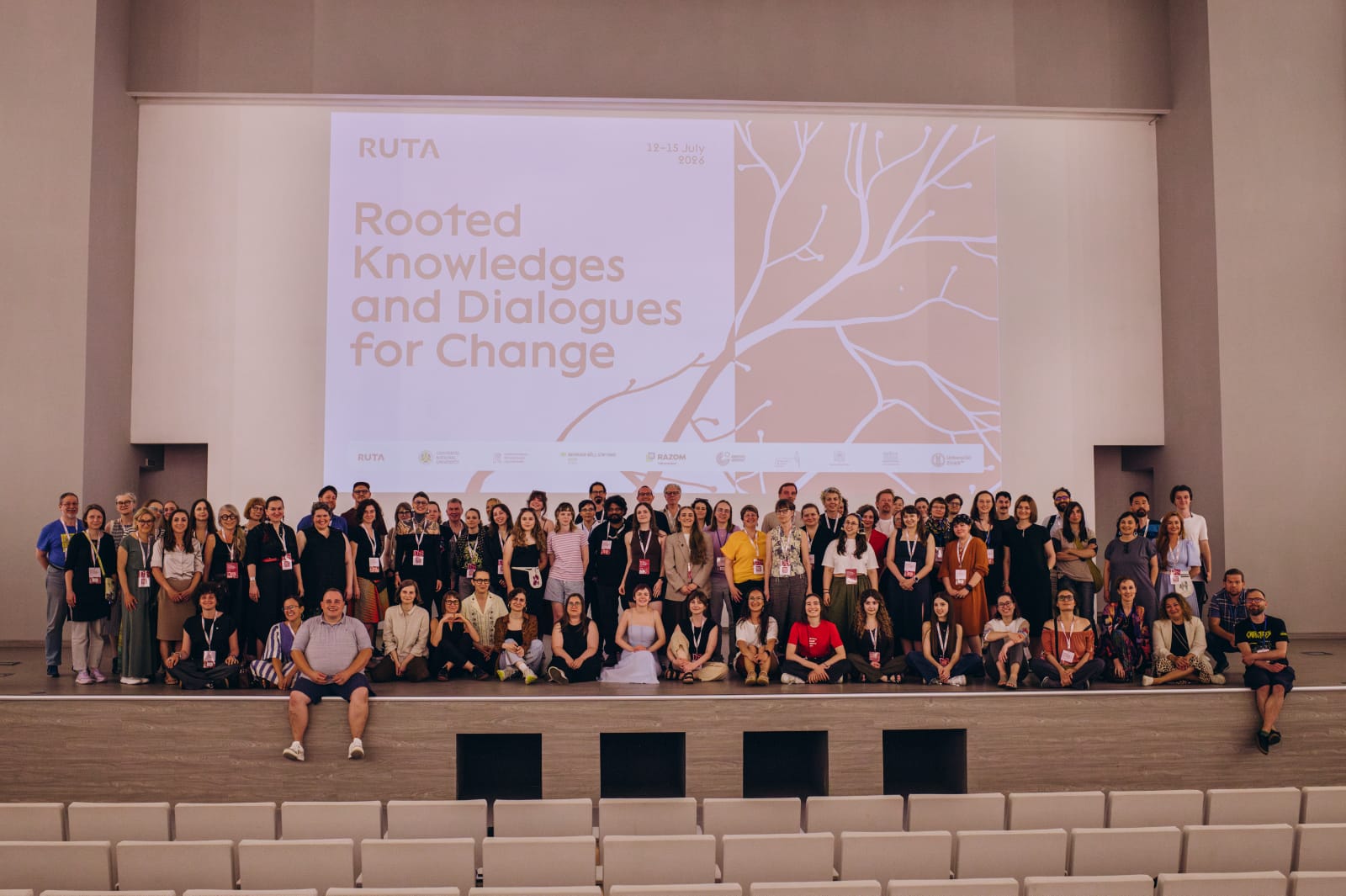
Uzhhorod, Ukraine – 12-15 July 2026 – The RUTA Association for Central, South-Eastern, Eastern European, Baltic, Caucasus, Central, and Northern Asian Studies has successfully concluded its third annual conference, “Rooted Knowledges and Dialogues for Change,” bringing together more than 200 participants from across the RUTA regions and beyond, for four days of cross-disciplinary dialogue and artistic engagement.
Hosted in partnership with Uzhhorod National University, the conference welcomed in-person and online scholars, artists, practitioners, partner organizations, volunteers, and members of the organizing team. Held from 12–15 July 2026 in Ukraine’s Zakarpattia region, the programme featured 58 panels, roundtables, workshops, film screenings, exhibitions, and performances. Against the backdrop of ongoing geopolitical shifts, the conference served as a vital platform for decentralized knowledge production and cross-regional solidarity. Reflecting this year’s theme, the conference explored a wide range of pressing questions, including the promises and limits of collaborative, feminist, and decolonial methodologies; environmental justice and the environmental legacies of colonialism; art as a site of resistance; disinformation and open-source intelligence (OSINT); questions of identity, belonging, and positionality; dynamics and experiences of forced migration; and the RUTA region(s) in dialogue with communities across Africa, Iran, Palestina, Xinjiang, and beyond.
At the opening ceremony, RUTA Board Member Grazina Bielousova, reflected on the central role that decoloniality has played both in shaping this year’s conference theme, and in the development of the RUTA Association more broadly:
“Decoloniality is a term and a critical approach that has gained major relevance in the RUTA regions especially after the full-scale Russian invasion of Ukraine in 2022. Before that, debates on decoloniality were a smaller trickle of intellectual thought — perhaps even more so in Eastern Europe than in Central Asia — and then, all of a sudden, decoloniality became a mainstream idiom of the regions that have experienced Russian colonial aggression and expansion, both historically and now. It gave us a way to understand ourselves and each other, to experience solidarity by naming the shared colonial trauma and losses, as well as the numerous ways of resistance.”
Featured panels included high-level dialogues such as “How Do We Make Art in Times of Violence: Between Positionality and Solidarity,” “Rooted and Environmental Knowledges,” and “Beyond Troll Farms and Border Violence: Defying Disinformation and Dehumanization.” Together, these sessions brought forward critical indigenous and local perspectives often marginalized in mainstream Western academia.
Speaking at the closing ceremony, RUTA Board Member Alexis Scott reflected on the significance of the Association in platforming these voices.
“For me, RUTA is an environment that is designed to hold space for ideas and conversations that find it difficult to thrive in other, especially academic contexts. It is an environment in which we have the opportunity to gather together, to learn from each other, to support each other to hold space for voices that continue to be marginalised both globally and within the RUTA regions themselves as a result of imperial and non-imperial structures of domination and oppression, as well as to argue, to disagree with one another, and to challenge one another.”
The conference was made possible through the dedication of volunteers, organizers, and partner institutions whose collective efforts brought this international gathering to life. For more information:
Website: https://ruta-association.org/
Email: contact@ruta-association.org
Follow RUTA on:
Facebook | Twitter / X | Instagram
The RUTA Conference 2026 was organized with the support of our partners: Uzhhorod National University and the Department of Archaeology, Ethnology and Cultural Studies; the International Renaissance Foundation; the Heinrich Böll Foundation Ukraine; Razom for Ukraine; Goethe-Institut Ukraine; the Ukrainian Studies Fund; Danyliw Foundation; Danyliw Research Seminar; and, the University of Zurich
About RUTA
The RUTA Association is a volunteer-led professional organization dedicated to fostering innovative, non-imperial, and multidisciplinary research across Central, South-Eastern, Eastern European, Baltic, Caucasus, Central, and Northern Asian studies.
The RUTA Association was established in response to Russia’s full-scale invasion of Ukraine. Taking its name from the Ukrainian ‘ruta’ plant, long known for its healing and anti-poisonous qualities, it is the first association that is based in the region and that centers the knowledge and expertise of local scholars, artists, and social justice advocates. RUTA’s first conference,, ‘Re(kn)own: Region(s) from Within’, was held on July 27-30, 2024, and examined persistent legacies of Russo-centrism, while and promoting critical research on imperial and colonial structures that have shaped the RUTA region(s) and beyond.