RUTA members Tereza Hendl and Joanna Karolina Malinowska are organising the GLOHRA workshop Mind the gap: engaging Europe’s East in global health debates
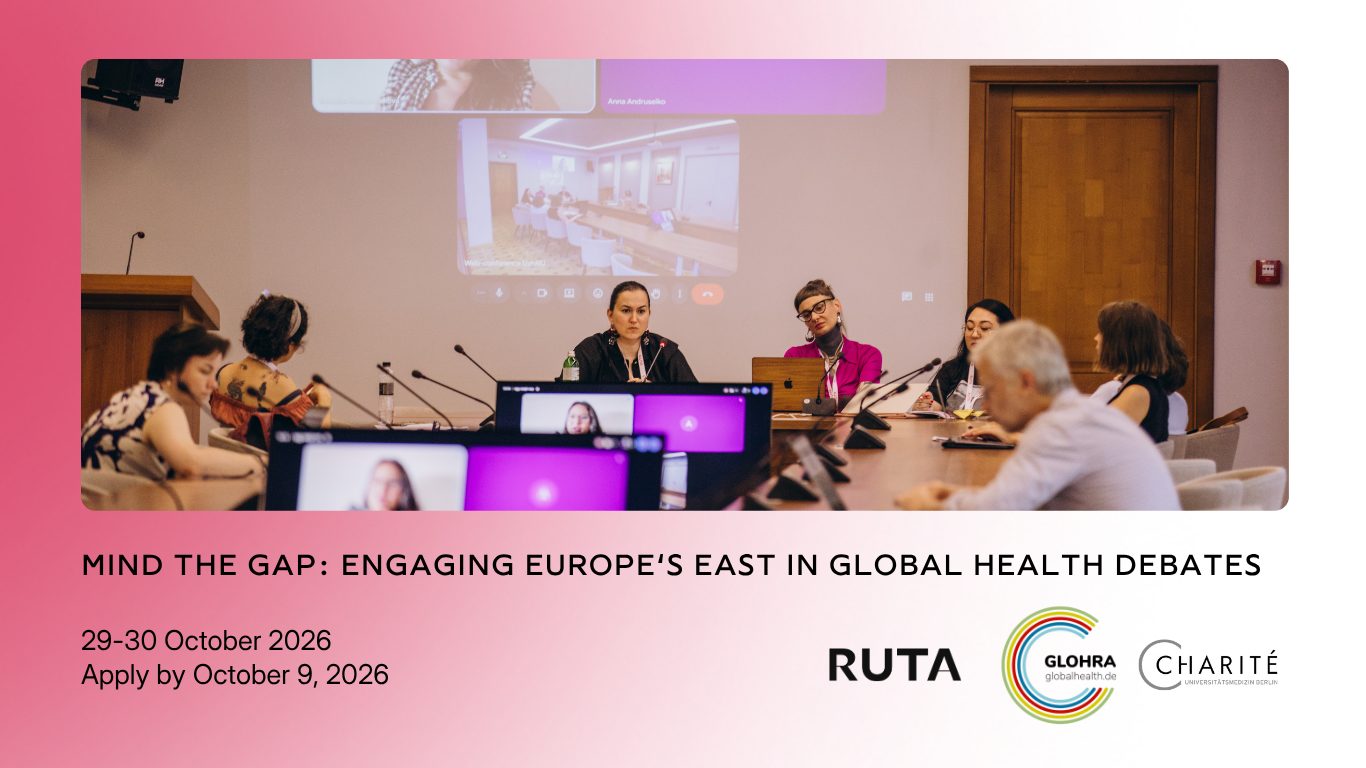
RUTA founder Dr Tereza Hendl (University of Augsburg) and RUTA member Dr Joanna Karolina Malinowska (Adam Mickiewicz University in Poznań) were awarded a grant from the German Alliance for Global Health research (GLOHRA) to organize a workshop that will explore the European East-West health gap, while prominently re-centring the interdisciplinary expertise of East-European scholars. The workshop is co-organised with Professor Kerem Böge and Dr Solveig Kemna from the Charité, and will be held in a hybrid format from October 29-30 at Charité, Berlin, Germany.
At this year’s RUTA conference in Ukraine, Dr Hendl and Dr Malinowska launched the RUTA Initiative for Public and Global Health. They invite RUTA members, along with fellow scholars and professionals working on concerns of public health and European East-West health inequities, to attend the GLOHRA workshop and learn more about the new initiative. Registration details are provided below.
GLOHRA workshop Mind the gap: engaging Europe’s East in global health debates
The workshop will address the invisibility and epistemically unjust representation of Eastern Europe, as well as the marginalisation of its scholarship, in global health debates. These problems limit an in-depth understanding of the health concerns affecting East-European populations and the design of effective responses. Global health research has often treated Europe as a homogeneous entity and equated it with its Western parts, disregarding the continent’s East and its sociohistorically specific health challenges (Malinowska 2026, Hendl forthcoming). These patterns have been further reinforced by reliance on conceptual frameworks developed outside Europe, particularly those based on the ethnoracial classifications established in the United States. Such frameworks do not adequately recognise East-Europeans as structurally vulnerable populations with context-specific health challenges and needs, and are thus ill-suited to capture the resulting disparities and identify appropriate strategies for their mitigation (Malinowska 2026). As a result, the specific health needs of East-European populations remain largely overlooked in global health research and policy discussions.
Yet epidemiological evidence demonstrates why the particular position of East-European populations must be recognised (Malinowska 2026). Despite the persistent tendency to aggregate populations from Eastern and Western Europe into one category, a growing body of epidemiological research documents an enduring East–West health gap. Although the disparity peaked in the early 1990s, life expectancy in Eastern Europe remains lower than in Western Europe (Zatonski 2007; Aburto & van Raalte 2018). Moreover, while migrants from Europe’s East often arrive in West-European countries with relatively good health, over time, they report lower levels of subjective well-being (Sand & Gruber 2018), more frequent multimorbidity (Jang et al. 2024) and higher mortality rates (Ikram et al. 2016) than native-born populations.
Similar patterns are observed beyond Europe. Recent migrants from Eastern Europe to the U.S. show significantly poorer outcomes across multiple indicators – including self-rated health, hypertension, disability, functional limitations, and mental health – compared with the U.S.-born white populations and other European-origin migrant groups (Read et al. 2021). These disadvantages persist after adjustment for education, smoking, alcohol use, and other standard covariates, and are not eliminated by longer residence; in many cases, health deteriorates over time (Read & Fairfax 2025). Finally, the need to understand these inequities has acquired renewed urgency since Russia’s full-scale invasion of Ukraine, which has displaced millions of people and caused widespread annihilation of life, disability, and trauma. Access to healthcare has also deteriorated: repeated attacks on Ukraine’s health system have damaged hospitals, clinics, ambulances, and other medical infrastructure, killed or injured healthcare workers and patients, and disrupted essential services (WHO 2026a, 2026b).
The increasing severity and urgency of East-West health disparities calls for a long-overdue exploration of the structural factors behind such persistent health inequities (Malinowska 2026). Although many differences in health outcomes are well documented, their underlying causes remain insufficiently examined, especially as concerns of health justice. Existing accounts point to the region’s historical context (Vågerö 2010), socioeconomic conditions, including the post-socialist economic transition and education, psychosocial mechanisms (Jutz 2020), healthcare-system factors (Popic & Schneider 2018), as well as lifestyle and cultural influences (Füssenich et al., 2019). While these studies offer important insights, their explanations remain fragmented, and relevant scholarship from the region is rarely engaged with in broader global discussions on health inequities. Concerningly, much of the debates in bioethics and global health equity research have reproduced a stereotypical, marginalising and essentialing outlook on Europe’s East and its populations, while failing to learn from regional expertise (Hendl & Browne 2023; Górska, Hendl & Majewska 2025; Malinowska 2026).
Recognising that epistemically just approaches to health challenges require research and policy leadership from affected populations, our workshop will bring together a transregional group of experts closely connected to East-European communities, including Ukrainians endangered and forcibly displaced by the ongoing Russian invasion, Romani populations and fellow intersectionally marginalised population groups. The workshop will significantly extend on existing explanations by foregrounding the sociopolitical structures that produce and sustain the East–West health divide. As such, we will discuss a broad range of concerns, stemming across the socioeconomic peripheralisation and resource extraction of the region, trajectories of economic and forced migration, unequal resources available for the adequate funding and staffing of East-European healthcare systems and the integration of the concerns of Europe’s East with similarly peripheralised societies of the global South(s), focusing in particular on the shared aspects of socio-historical experiences with Central Asia.
Our major objectives include the overdue thematisation of East-European health concerns through the lens of socio-political determinants of health, that robustly engages with structural issues of health equity and justice. The workshop will contribute to a major reassessment and rethinking of debates on East-European health challenges, their structural causes, and warranted solutions. The workshop is planned as one of the starting points of a much larger series of follow-up debates organised in cooperation with the RUTA Association Initiative for Public and Global Health. Crucially, the workshop discussions will be held in an epistemically validating and supportive environment, prominently centering the direct expertise of affected societies in epistemically just and reparative ways, that have the potential to majorly inform and deepen global health debates. The workshop will be held in a hybrid format, to enable the participation of remote speakers as well as a wider cohort of GLOHRA researchers.
Our confirmed speakers include: Valentyna Mazhbits, Botakoz Kassymbekova, Daniel James, Dora Vargha, Bogdan Cristian Iacob, Judit Sándor, Petra Ezzeddine, Joanna Talewicz, Lois Orton, Olga Fuseini, and Dominika Pszczółkowska-Mościcka.
Workshop organisers: Tereza Hendl, Joanna Karolina Malinowska, Kerem Böge, Solveig Kemna
The full programme will be published closer to the workshop date.
Registration is essential, see the form here. The workshop is limited to 30 in-person participants. Please fill the registration form by October 9, 2026.
https://forms.gle/BK38QJL5oYXi3weN6
Participation in the workshop, including catering during the event, is free of charge. However, participants are expected to cover their own travel and accommodation.
Literature referenced in the text:
Aburto, J. M., & van Raalte, A. (2018). Lifespan dispersion in times of life expectancy fluctuation: The case of Central and Eastern Europe. Demography, 55(6), 2071–2096. https://doi.org/10.1007/s13524-018-0729-9
Füssenich, K., Nusselder, W. J., Lhachimi, S. K., Boshuizen, H. C., & Feenstra, T. F. (2019). Potential gains in health expectancy by improving lifestyle: An application for European regions. Population Health Metrics, 17, Article 1. https://doi.org/10.1186/s12963-018-0181-5
Hendl, T., and T. Kayali Browne (2022). Gender: Ongoing Debates and Future Directions. Pp. 151-166 in W. Rogers, S. Carter, V. Entwistle, C. Mills, J. Leach Scully. Routledge Handbook of Feminist Bioethics. London and New York: Routledge. https://doi.org/10.4324/9781003016885-14
Górska, M., Hendl, T., and E. Majewska. (2025). Metamorphic Necropolitics: Deadly Othering in the European East-West Power Relations. Pp. 154-164 in Lykke, N., Radomska, M., and T. Mehrabi. Routledge Handbook of Queer Death Studies. New York: Routledge. https://doi.org/10.4324/9781003398486-14
Hendl, T. (forthcoming). Layers of Harm and Trauma: Towards Accounting for the Impact of Russian and German Imperialism on Health and Wellbeing in Europe’s East. In Razum, O., Silva, D., Hubeladze, I., and Y. Namer. States’ Exclusionary Practices and Consequences for Public Health. Heidelberg: Metzler Verlag.
Ikram, U. Z., Mackenbach, J. P., Harding, S., Rey, G., Bhopal, R. S., Regidor, E., Rosato, M., Juel, K., Stronks, K., & Kunst, A. E. (2016). All-cause and cause-specific mortality of different migrant populations in Europe. European Journal of Epidemiology, 31(7), 655–665. https://doi.org/10.1007/s10654-015-0083-9
Jang, S. Y., Loi, S., van Lenthe, F. J., Oksuzyan, A., & Myrskylä, M. (2024). Inequalities in multimorbidity between older migrants and natives across Europe (MPIDR Working Paper WP-2024-003). Max Planck Institute for Demographic Research. https://doi.org/10.4054/MPIDR-WP-2024-003
Jutz, R. (2020). Health inequalities in Eastern Europe: Does the role of the welfare regime differ from Western Europe? Social Science & Medicine, 267, Article 113357. https://doi.org/10.1016/j.socscimed.2020.113357
Malinowska, J. K. (2026). White by default: Conceptual and methodological limits of binary white logic in global health equity research. Medicine, Health Care and Philosophy, 29(2), 261–281. https://doi.org/10.1007/s11019-026-10330-w
Popic, T., & Schneider, S. M. (2018). An East–West comparison of healthcare evaluations in Europe: Do institutions matter? Journal of European Social Policy, 28(5), 517–534. https://doi.org/10.1177/0958928717754294
Read, J. G., & Fairfax, F. G. (2025). Hidden heterogeneity: How the White racial category masks interethnic health inequality. Demography, 62(1), 237–261. https://doi.org/10.1215/00703370-11790429
Read, J. G., Lynch, S. M., & West, J. S. (2021). Disaggregating heterogeneity among non-Hispanic Whites: Evidence and implications for U.S. racial/ethnic health disparities. Population Research and Policy Review, 40(1), 9–31. https://doi.org/10.1007/s11113-020-09632-5
Sand, G., & Gruber, S. (2018). Differences in subjective well-being between older migrants and natives in Europe. Journal of Immigrant and Minority Health, 20(1), 83–90. https://doi.org/10.1007/s10903-016-0537-5
Vågerö, D. (2010). The East–West health divide in Europe: Growing and shifting eastwards. European Review, 18(1), 23–34. https://doi.org/10.1017/S106279870999010X
WHO (World Health Organization Regional Office for Europe). (2026a, May 8). 3000 attacks on health care in Ukraine verified by WHO since full-scale invasion. https://www.who.int/europe/news/item/08-05-2026-3000-attacks-on-health-care-in-ukraine-verified-by-who-since-full-scale-invasion
World Health Organization Regional Office for Europe. (2026b, February 6). Ukraine: WHO seeks US$ 42 million in 2026 to protect health care as war enters its fifth year. https://www.who.int/europe/news/item/06-02-2026-ukraine–who-seeks-us-42-million-in-2026-to-protect-health-care-as-war-enters-its-fifth-year
Zatonski, W. (2007). The East–West health gap in Europe—What are the causes? European Journal of Public Health, 17(2), 121. https://doi.org/10.1093/eurpub/ckm006